 Toolvia
VIN recall check
Check any vehicle for safety recalls by VIN. We look up the official NHTSA recall database and show every recall for that make, model and year, with the problem, the risk and the free fix.
What a recall is
A safety recall happens when a manufacturer or NHTSA decides that a vehicle has a defect that creates a safety risk, or that it doesn’t meet a federal safety standard. The manufacturer then has to notify owners and fix the problem. Common examples include airbags that may not deploy correctly, fuel leaks, brake problems and software faults.
Recall repairs are usually free
Under federal law, the manufacturer must fix a recalled safety defect at no cost to you. That’s true whether you bought the car new or used, and whether or not it’s still under warranty. The main exception is age: manufacturers generally aren’t required to provide a free remedy on vehicles first sold more than 15 years before the recall. Tires have their own, shorter rules.
How to check recalls by VIN
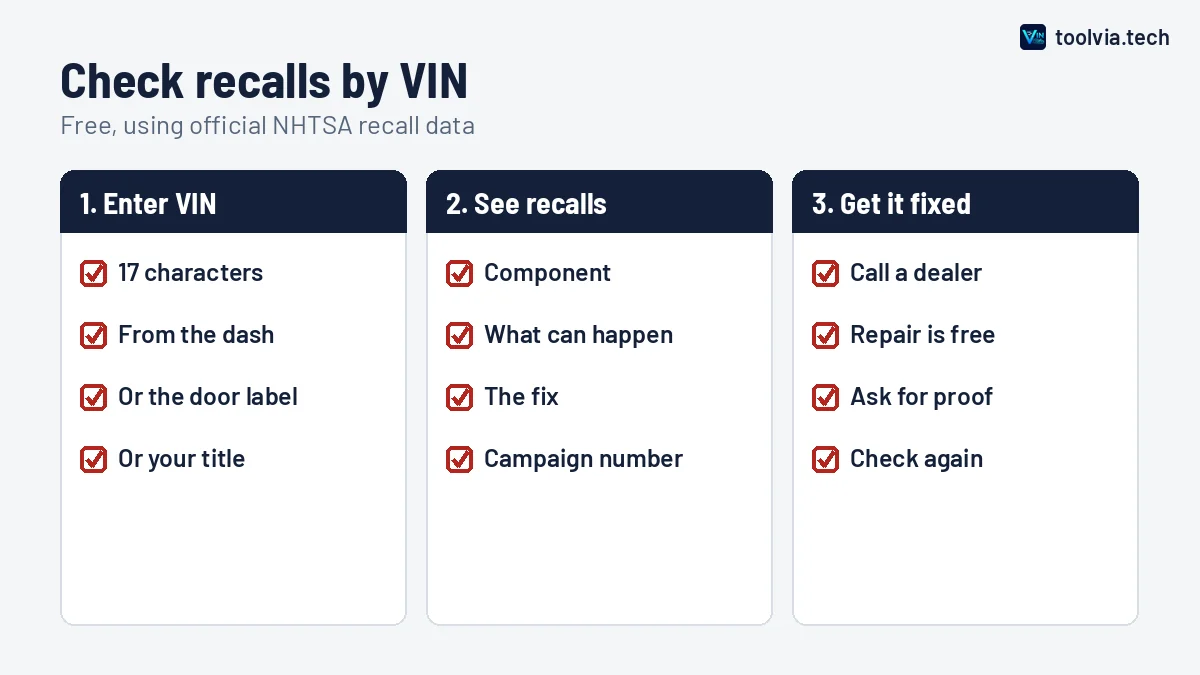
- Find your VIN. It’s on the dashboard at the base of the windshield, on the driver’s door label, and on your registration and insurance card. More places to look.
- Enter it above. We decode the VIN and pull every recall NHTSA has for that make, model and year.
- Read each recall. You’ll see the part involved, what can go wrong, the fix, and the NHTSA campaign number.
- Confirm your car’s status. To see whether your specific vehicle has already been repaired, enter the VIN at nhtsa.gov/recalls or give it to a dealer’s service department.
Model-year recalls vs your exact car
This is the part that confuses most people. A recall is issued for a group of vehicles, often a model across one or more years, sometimes only those built at a certain plant or in a certain date range. Our check shows recalls for your make, model and year, which is the right first step when you’re researching a car.
The manufacturer keeps the record of which individual cars are included and which have been repaired. That’s why the final word on an open recall comes from the manufacturer or a dealer, using your VIN.
Buying a used car with an open recall
An open recall isn’t a reason to walk away, but it is a reason to ask. Find out whether the work has been done and ask for the dealer’s repair order. If it hasn’t, you can usually get it done for free after you buy, but some repairs take time while parts are on order. For serious recalls, like airbags, it’s worth getting the fix before you drive the car regularly.
If you’re shopping, our AI used car checker combines recalls with owner complaints and the seller’s listing to build a checklist for the exact car.
Recall, complaint or service bulletin?
A recall is an official safety campaign with a free fix. A complaint is a report an owner files with NHTSA; it isn’t a confirmed defect, but many complaints about the same part are a useful warning. A technical service bulletin is guidance from the manufacturer to dealers on fixing a known issue. Bulletins aren’t recalls, so the repair isn’t automatically free, but they’re worth asking a dealer about if you have a matching problem.
Frequently asked questions
Is checking recalls by VIN free?
Yes. Our recall check is free and uses NHTSA’s public recall database. Recall repairs themselves are also free at an authorized dealer in most cases.
Does this show whether my car’s recall was already fixed?
Our list shows recalls issued for your make, model and year. Whether your specific car has been repaired is tracked by the manufacturer, so confirm it by entering your VIN at nhtsa.gov/recalls or calling a dealer.
How often are new recalls added?
Manufacturers file new recalls throughout the year. We check NHTSA live each time, so it’s worth checking again every few months.
Can I get a recall fixed at any dealer?
Usually any authorized dealer for your brand can do the repair, even if you didn’t buy the car there. Call ahead, because parts for new recalls are sometimes on backorder.
Do recalls apply to used cars?
Yes. A recall follows the vehicle, not the owner, so a used car is covered the same way a new one is.