 Toolvia
How to use the VIN decoder
- Find the VIN on the dashboard through the windshield, on the driver’s door jamb label, or on your title or insurance card. More places to look.
- Type or paste all 17 characters. The boxes fill in as you type and flag the letters I, O and Q, which VINs never use.
- Select Decode VIN. You’ll get the specs first, then the character-by-character breakdown, recalls, complaints and crash ratings.
What the decoder can and can’t tell you
A VIN is a build record. It tells you the year, model, body, engine and factory, and because NHTSA tracks recalls and complaints by model, it’s also the fastest way to check a vehicle’s safety record.
What it won’t show is the vehicle’s life since it left the factory: accidents, mileage, owners or a salvage title. If you’re buying a used car, decode the VIN here first to make sure the car is what the seller says, then consider a paid history report and an inspection by a mechanic you trust.
Recalls, complaints and crash ratings: what’s the difference?
The three safety sections in a report come from different NHTSA programs and mean different things.
Recalls are official campaigns where a manufacturer or NHTSA has confirmed a safety defect. The repair is free at an authorized dealer, even if the car is used and out of warranty. Our list covers recalls for the same make, model and year; to confirm whether a specific car has been repaired, check its VIN at nhtsa.gov/recalls or ask a dealer.
Complaints are reports filed by owners. They aren’t confirmed defects, but a cluster of complaints about the same part, such as the transmission or airbags, tells you what to look at closely on a test drive.
Crash test ratings come from NHTSA’s New Car Assessment Program, which awards one to five stars for frontal, side and rollover performance. Not every model is tested every year, so older and low-volume vehicles often have no rating.
Decoding trucks, motorcycles and trailers
The same decoder works for any vehicle with a 17-character VIN, but how much detail you get depends on what the manufacturer reported.
Pickups and vans usually decode in full, including the weight class (GVWR), which is useful for towing and payload. Motorcycles typically show the make, model, year, engine size and plant. You’ll find the VIN on the steering neck of the frame. Trailers from large manufacturers decode with the make, year and trailer type, while those from small builders may show little more than the manufacturer and year. The VIN plate is usually on the tongue or the front of the frame.
If a VIN returns very few details, that doesn’t mean it’s fake. It usually means the builder reported only the basics to NHTSA.
Where the data comes from
Specs come from NHTSA’s Product Information Catalog and Vehicle Listing (vPIC), which is built from information manufacturers are required to submit. Recalls, owner complaints and crash test ratings come from NHTSA’s public safety databases. We query them live each time you decode, so you always see the latest records.
Frequently asked questions
Is this VIN decoder really free?
Yes. There’s no signup and no limit. The specs come from NHTSA’s free public vPIC database, and recalls, complaints and ratings come from NHTSA’s other public databases.
Does it show accident or title history?
No. A VIN decoder shows how the vehicle was built and its official safety records. Accident, title and ownership history come from paid vehicle history reports.
Why can’t I type I, O or Q?
VINs never use those letters because they look like 1 and 0. If your VIN seems to have one, it’s almost always a 1 or a 0.
The check digit failed. Is the VIN fake?
Usually it means one character was typed wrong, so check it again. Vehicles built for markets outside North America sometimes don’t use a check digit.
Why are some fields missing?
Manufacturers report different amounts of detail to NHTSA. Older vehicles, motorcycles and imports often have fewer fields.
Are the recalls for my exact car?
The list covers recalls for the same model and year. To see whether a specific vehicle has already been repaired, enter its VIN at nhtsa.gov/recalls or ask a dealer.
VIN decoder by make
Guides
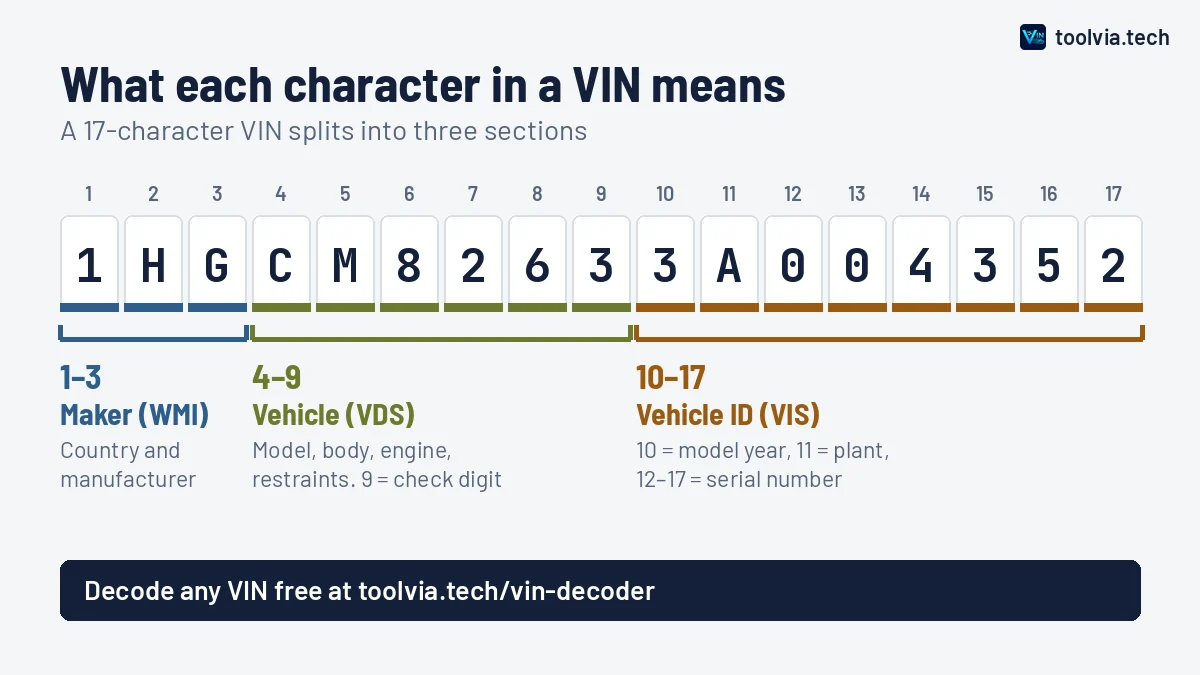
A plain-English guide to all 17 characters of a VIN: the maker code, vehicle details, check digit, model year, plant…
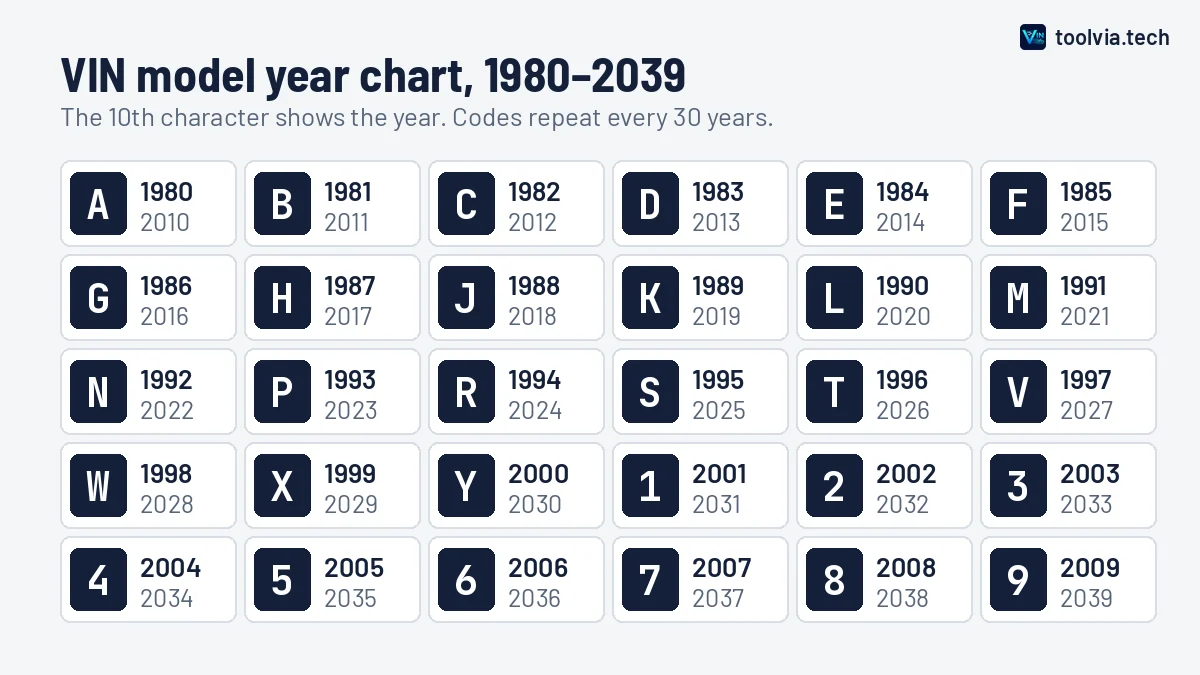
Find any vehicle’s model year from the 10th character of its VIN. A complete chart from 1980 to 2039, plus the simple…
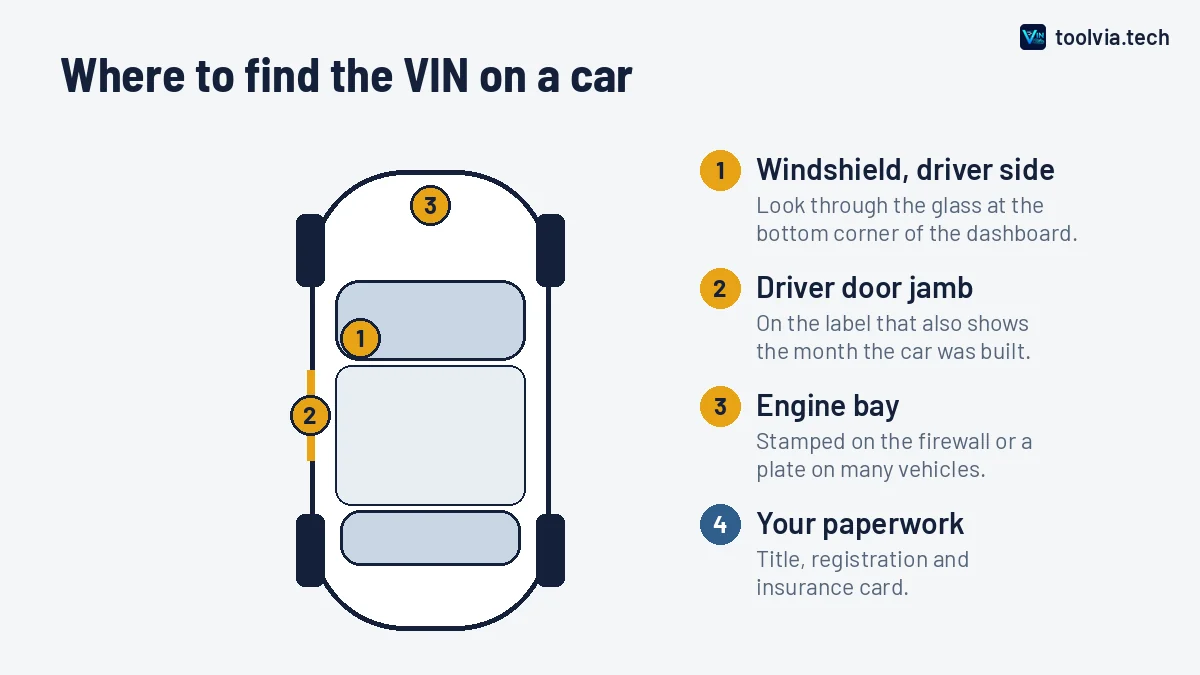
The quickest places to find a VIN on a car, truck, motorcycle, trailer or RV, plus which documents show it and what to…
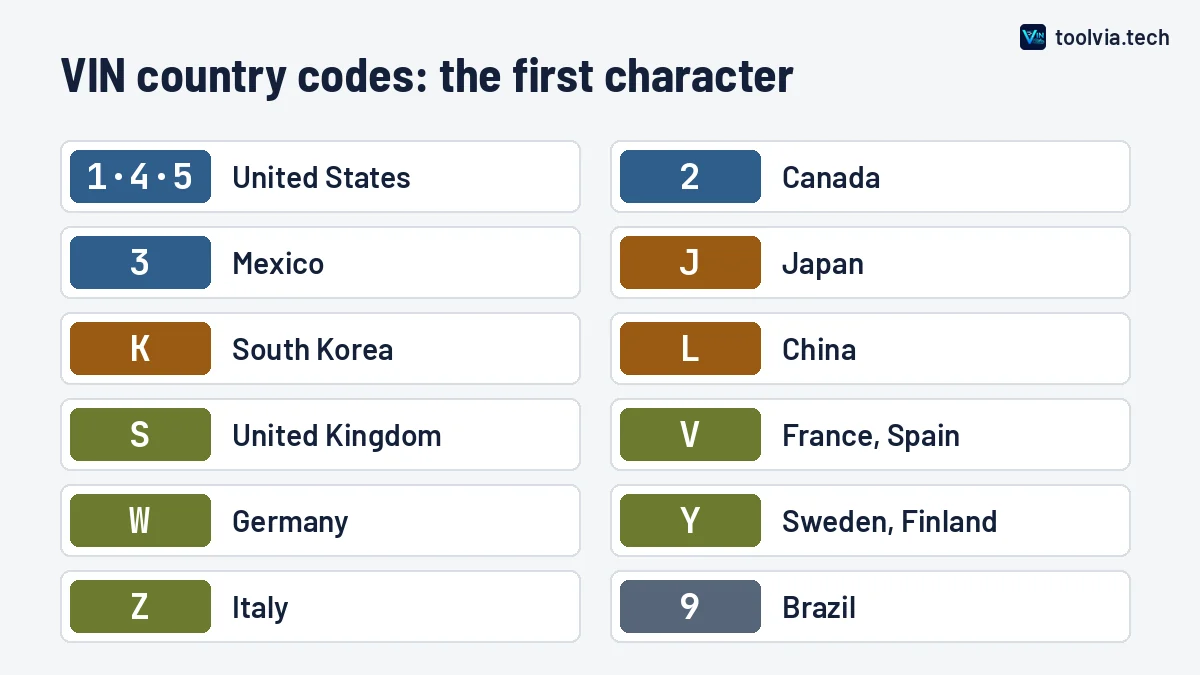
The first character of a VIN shows where a vehicle was built. See the full list of VIN country codes, how the second…