 Toolvia
Trailer VIN decoder
Trailers built for road use in the US have a 17-character VIN, from big travel trailers to small utility and boat trailers. Because so many trailers come from small builders, trailer VINs follow a few rules that car VINs rarely need.
Enter the VIN below to see what the manufacturer reported to NHTSA. Large brands usually decode with the type and year, while small builders may show only the basics.
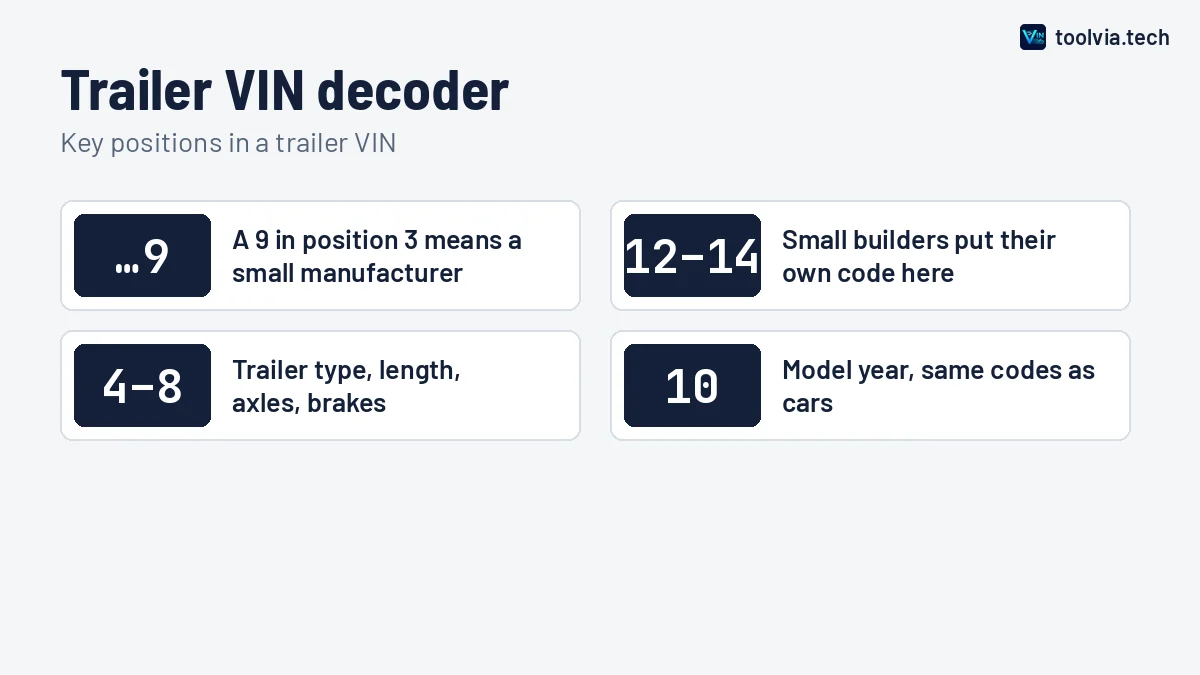
How a trailer VIN is laid out
Trailer VINs use the same 17 positions as cars. These parts are the most useful to know:
| Position | Meaning |
|---|---|
…9 | A 9 in position 3 means a small manufacturer |
12–14 | Small builders put their own code here |
4–8 | Trailer type, length, axles, brakes |
10 | Model year, same codes as cars |
Not sure what the rest of the characters mean? Our guide to what each digit in a VIN means walks through all 17, and the VIN year chart shows how to read the model year from the 10th character.
How to read a trailer VIN
Small builders use a special code
Manufacturers that build fewer than 1,000 vehicles a year put a 9 in the third position of the VIN, and their own three-character code in positions 12 to 14. Many trailer makers are in this group, so don’t be surprised to see it.
Positions 4 to 8 describe the trailer
Builders use these to record things like the trailer type, body style, length, number of axles and brake type. Each builder chooses its own codes, which is why decoding depends on what they reported to NHTSA.
Homemade trailers get a state VIN
A homemade trailer has no factory VIN. Most states issue their own VIN after an inspection, often as a plate or sticker. If you’re buying a trailer with no VIN at all, check with your state DMV before you pay, because registering it can take time.
Before you buy a used trailer: what to check with the VIN
Once you’ve decoded the VIN, these are the trailer-specific things worth comparing against the listing.
Make sure there is a VIN
A trailer with no VIN plate can be hard to title and register. Find out what your state requires before you buy.
Match the VIN to the title
Check every character on the trailer against the title. Small plates wear and fade, so take a photo and zoom in.
Check the weight rating
Look for the GVWR on the VIN plate or sticker and make sure your vehicle can tow it safely.
Where to find the VIN on a trailer
Most trailers have the VIN on a plate or sticker on the tongue, the A-frame at the front, or on the front of the frame rail on the driver’s side. On travel trailers and RVs it’s often also on a label near the entry door. It’s also on the title or registration. See all the places to look.
Frequently asked questions
Do trailers have a VIN?
Yes. Trailers built for road use in the US have a 17-character VIN. Homemade trailers get a VIN from the state after inspection.
Where is the VIN on a trailer?
Usually on the tongue or the front of the frame, on the driver’s side. Travel trailers often have a label near the door as well.
Why does my trailer VIN show so little information?
Small builders often report only basic details to NHTSA. A VIN with a 9 in the third position comes from a small manufacturer.
Can I check trailer recalls by VIN?
Yes, if the builder reported the trailer to NHTSA. Use our recall check, and for travel trailers also check for recalls on appliances like the furnace or fridge with their makers.
Trailer is a trademark of its owner. Toolvia is an independent site and isn’t affiliated with Trailer. Decoded details come from data the manufacturer reports to NHTSA.